Skip to content
 Henrik Follesø Egeland
Extended Dissolve
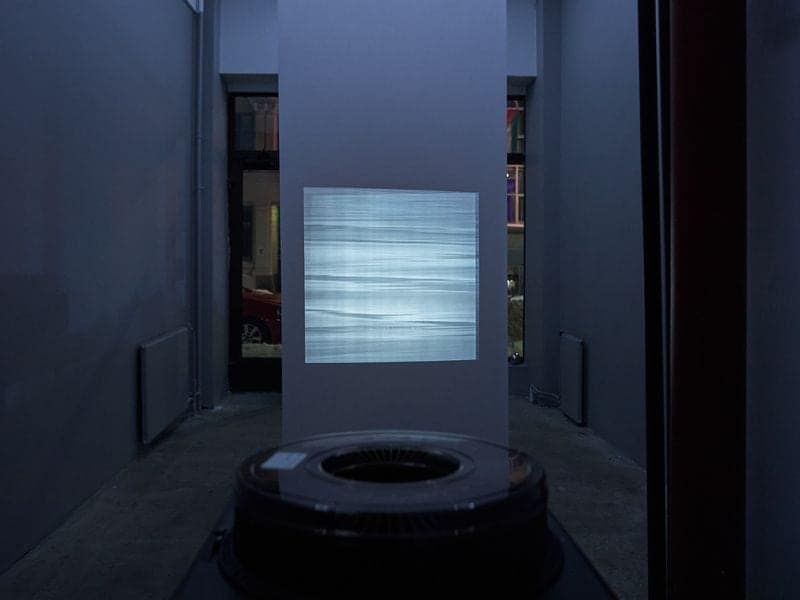
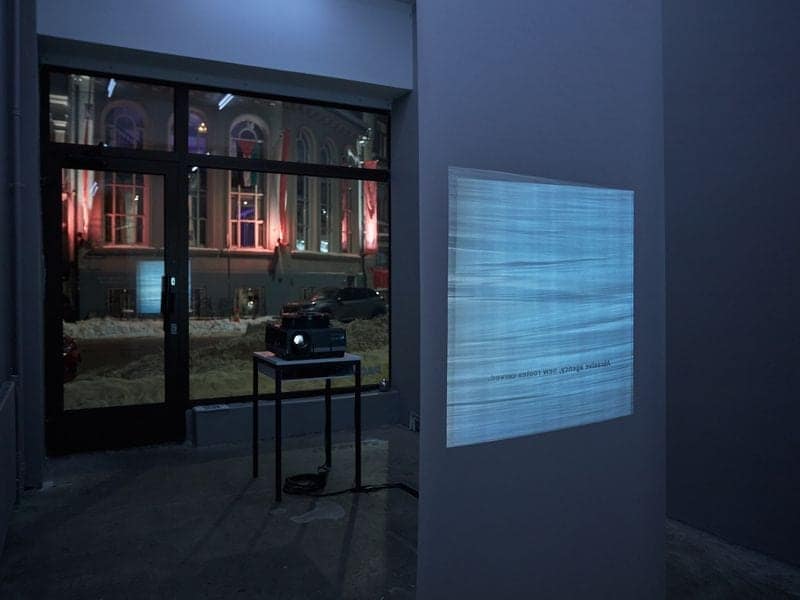
Using slit-scan photography and 1970s image slide PAX dissolve units, Henrik Follesø Egeland’s Extended Dissolve takes a closer look at the static image in a constant state of change.
Through a combination of double- and back-projection techniques, Extended Dissolve experiments with still images in continuous dissolution. The slides on show have been captured in a specially constructed slit-scan camera – the technology most commonly used in finish line photos – at the Gudbrandsdalslågen river in south-eastern Norway. In conjunction with two image projectors, the installation is controlled by a Dataton system allowing the images to be in a constant process of seamless transition, collapsing the common idea of the photographic moment.
The term “dissolve” plays a central role in the work, carrying a dual significance of both a technical process and a poetic potential. It is a state that is uniquely characterised by its simultaneous passivity and activity, where constructive processes coexist with elements of dissolution.This exhibition is the first presentation of preliminary results from the residency Dataton Dialogues. Phase 1, centred around production, research and experimentation took place in October–November; phase 2, in December–January, now seeks to open the process to the public through talks, presentations and visits.
Organised in collaboration with PRAKSIS, the residency Dataton Dialogues brings Tris Vonna-Michell and Henrik Follesø Egeland to work at Pachinko from 23 October 2023 to January 2024, during which they will use a 1970s Dataton MIC 3 Programmer for PAX dissolve units to generate audiovisual experiments.
Henrik Follesø Egeland (b. 1994) is an Oslo-based visual artist and photographer, and a graduate from the Oslo National Academy of Arts (MFA) as well as the University of Roehampton (BFA). Through a technical engagement with photography, his work operates both within and outside traditional photographic representation. Exploring alternative means of photographic recording and reproduction, as well as possibilities of transmutation. This technical experimentation is used as an investigative approach, to explore ideas of landscape, memory and perceptions of reality. Pulling together webs of interconnected yet disparate ideas and notions, into new constellations.